The Right Way to Build Your Brand
一个多世纪以前,商人约翰·沃纳梅克( John Wanamaker)曾挖苦抱怨道:“我花在广告上的钱有一半是浪费的。问题是,我不知道是哪一半。”因为广告的支持者们一直难以证明广告投放的钱花得值,这种对投放效果的指责一直以来让财务高管削减广告预算显得合理。正如另一位权威人士,宝洁公司前CMO吉姆·斯坦格尔(Jim Stengel)所说,尽管有大量资源用于测试广告文案、衡量效果,但是这种斗争仍在继续。
More than a century ago the merchant John Wanamaker wryly complained, “Half the money I spend on advertising is wasted. The trouble is, I don’t know which half.” Because the proponents of advertising have always struggled to prove that the money is well spent, that indictment has long helped financial executives justify cutting ad budgets. As no less an authority than Jim Stengel, a former chief marketing officer at Procter & Gamble, has noted, the struggle continues, although huge resources go toward testing advertising copy and measuring effectiveness.
随着在线广告和“效果营销”(performance marketing)的出现,战斗变得更加艰难。“效果营销”是指为了捕获和转化已经到达品牌销售漏斗顶部(无论出于何种原因)的潜在需求而进行的支出。换句话说,就是广告商为点击付费。然而,旨在帮助企业建立品牌、产品或服务的知名度,以强化定位和增加客户忠诚度的广告活动——即“品牌广告”的领域,广告支出与积极财务结果之间的联系更加微弱。结果是,潜在的品牌建设者面临着双重挑战:沃纳梅克的长期批评,和效果营销作为一种合理替代方案的崛起。一家标志性时尚服装品牌的CEO最近告诉本文作者,“我发现在名义上由我自己控制的组织中,都不可能保护品牌广告免受效果广告支出的影响。”
The battle has become tougher with the advent of online advertising and “performance marketing”—that is, spending to capture and convert potential demand that has already arrived (for whatever reason) at the top of a brand’s sales funnel. In other words, the advertiser pays for clicks. However, in what is now called “brand advertising”—designed to help establish awareness for a brand, a product, or a service to strengthen identity and increase customer loyalty—the link between advertising spending and positive financial outcomes is more tenuous. The result is that would-be brand builders face the dual challenge of Wanamaker’s long-standing critique and the rise of performance marketing as a perceived legitimate alternative. The CEO of an iconic fashion clothing brand told one of us recently, “I am finding it impossible in my own organization, which notionally I control, to protect brand advertising against performance advertising spending.”
我们终于为沃纳梅克的批评找到了答案,也一并为投资品牌建设找到了理由。通过使用世界广告研究委员会(WARC)提供的大型数据库,我们用实证方法确定了哪些类型的品牌广告对于吸引新客户并将他们转化为忠实的回头客最有效。正如我们将在下文解释的那样,成功品牌建设的关键是向客户做出明确而具体的承诺,并且显著地兑现。做出这种承诺的广告活动,几乎总是比没有做出承诺的广告表现更好,即使后者创造了更高的品牌知名度。一个精心设计的客户承诺不仅直接带来销售,而且还提供了一个有效框架来组织公司的各种活动。
We finally have an answer for Wanamaker—and a coherent rationale for investment in brand building. We drew on a large database supplied by the World Advertising Research Centre (WARC) to empirically identify what types of brand advertising are most effective both for attracting new customers and for converting them into loyal repeaters. As we’ll explain, the key to successful brand building is a clear and specific promise to the customer that can be demonstrably fulfilled. Advertising that makes such a promise almost always results in better performance than advertising that does not—even if the latter creates greater name awareness. And a well-designed customer promise not only leads directly to sales but also provides an effective framework on which to organize a company’s activities.
让我们先解释一下“客户承诺”是什么意思。
Let’s begin by explaining what we mean by a “promise to the customer.”
承诺,承诺……
Promises, Promises…
当一个人对另一个人做出承诺,两人之间就建立起一种关系。如果承诺被兑现,它会建立信任,带来有价值的联结。有确凿的研究表明,做出承诺并兑现承诺,对接受者的积极影响,大过仅仅为对方提供帮助或服务。
When one person makes a promise to another, it creates a relationship between the two. If the pledge is fulfilled, it builds trust, resulting in a valuable connection. Research shows conclusively that making a promise and then delivering on it has a greater positive impact on the recipient than simply doing a favor or a service for that person.
来看美国保险业三个竞争者的三个承诺:好事达(Allstate)的“你会没事的”(You’re in good hands);全美互惠保险公司(Nationwide)的“全美互惠在你身边”(Nationwide is on your side);以及盖可公司(Geico)的“15分钟可为你节省15%”(15 minutes could save you 15%.)。只有盖可的承诺是直接且可验证的。它承诺只需15分钟的时间就可以为顾客节省15%的保险费。这样就和顾客建立了联结。如果你花15分钟时间确实节省了15%(或更多)的钱,公司就建立了信任。而好事达和全美互惠暗示了承诺,但本质上是对他们自己而不是对客户的承诺:我们会照顾好你、我们站在你这边。他们的承诺是不可验证的。具体而言,怎样算是照顾“好”?怎样算是“站在你这边”?
Consider these three promises from competitors in the same industry: Allstate’s “You’re in good hands,” “Nationwide is on your side,” and Geico’s “15 minutes could save you 15%.” Only Geico’s is direct and verifiable. It promises that just 15 minutes of your time can save you 15% over your current insurance. That creates a connection. And if you take the 15 minutes and save 15% (or more), the company has built trust. Allstate and Nationwide imply promises—but essentially about themselves rather than the customer: Our hands are good hands, and we are on your side. Their promises aren’t verifiable. What does “good” mean in practice? And how does “on your side” play out?
这些差异让我们不禁思考:品牌建设活动的成败,是否与它做出的承诺类型有关?客户是否会对做出特定承诺并且明确兑现的品牌,做出更积极的反应?为了回答这些问题,我们求助于WARC(戛纳金狮广告奖的同门机构,负责组织国际创意节)。WARC的数据库包括来自世界各地广告竞赛的24000多个案例研究。主办方要求参赛者解释他们的营销传播是如何运作的——既包括软性绩效指标,比如对品牌知名度的影响;也包括硬指标,比如市场份额的增加。
Those differences made us wonder: Could the success of a brand building campaign be related to the type of promise it made? Would customers respond more favorably to a brand that made and then clearly delivered on a specific promise? To answer those questions, we turned to WARC (a sibling of Cannes Lions, which organizes the International Festival of Creativity). WARC’s database includes more than 24,000 case studies, drawn from ad competitions all around the world. The competitions require entrants to explain how their marketing communications have worked—including soft performance metrics, such as impact on brand perception, and hard measures, such as gain in market share.
我们研究了2018-2022年参赛的超过2000个广告活动的数据。在查看任何绩效指标之前,我们根据它们是否向客户做出了明确且可验证的承诺,对这些活动进行了分类,其中大约60%(2021个中有1213个)没有包含这样的承诺,而其余的(808个)则包含了承诺。
We studied the data for more than 2,000 campaigns that had entered competitions from 2018 to 2022. Before looking at any of the performance metrics, we classified the campaigns according to whether they had made an explicit and verifiable promise to customers. About 60% (1,213 of 2,021) included no such promise, while the remainder (808) did.
然后,我们在各个指标上比较了两组活动。客户承诺(Customer promise,以下简称CP)活动在大多数指标上的表现优于其他活动。例如,在品牌形象、品牌偏好和购买意图方面,56%的CP活动报告有所改善,而其他广告活动为38%。45%的CP活动带来市场渗透率增加,其他广告活动为38%。27%的CP活动带来市场份额增加,其他广告活动为17%。但其他广告活动并非在所有指标上表现不佳。比如,在制造社交媒体热度上,其他广告活动的表现远远超过CP活动(55%至43%)。
We then compared the two groups on a variety of metrics. Customer promise (CP) campaigns outperformed other campaigns across most measures. For example, on measures of brand perception, brand preference, and purchase intent, 56% of CP campaigns—versus 38% of others—reported improvement. Market penetration increased in 45% of CP campaigns versus 38% of other campaigns, and market share increased in 27% of CP campaigns versus 17% of others. That is not to say that other campaigns didn’t perform well on some measures. They beat CP campaigns soundly (55% to 43%) on generation of social media buzz, for example.
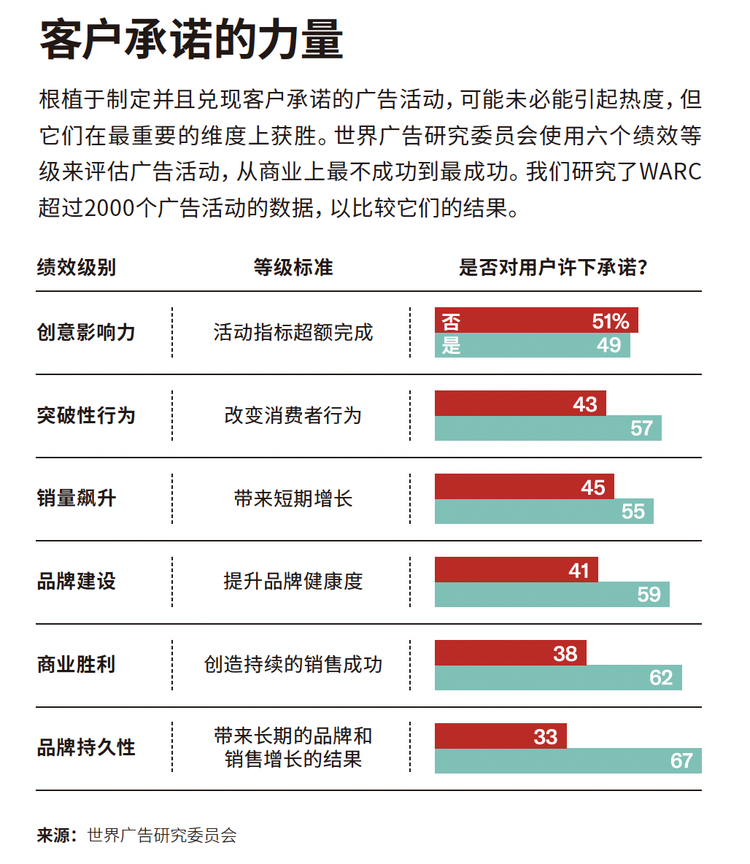
但是CP活动在重要指标上获胜。WARC将活动按六个递增的绩效等级进行排名(参见图表“客户承诺的力量”),不成功的活动不会进入等级。在最低级别的“创意影响力”上,非CP广告活动略优于CP广告活动(51%对49%)。但随着类别越来越重要,CP广告活动相对于非CP广告活动的优势越来越大,在“商业成功”上以62%超越38%,在“品牌持久性”上以67%超越33%。
But CP campaigns win on the important metrics. WARC ranks campaigns in a hierarchy of six ascending levels of performance. Unsuccessful campaigns don’t make it into the hierarchy. Non-CP campaigns outperform CP campaigns slightly (51% to 49%) on the lowest level: “influential idea.” But as the categories become more important, the advantage of CP over non-CP campaigns grows, with 62% over 38% in “commercial triumph” and 67% over 33% in “enduring icon.”
客户承诺(CP)包括什么?
What Does a Customer Promise Involve?
我们首先研究了808个CP活动数据库所做的承诺类型。大多数承诺可分为三种类型,89%的广告活动至少做出了一种类型的承诺。有些活动做了不止一种。
We began by looking at the kinds of promises made in our dataset of 808 CP campaigns. The majority of promises fell into three types, and 89% of campaigns made at least one type. Some made more than one.
-情感型。也许令人意外,这是最大的类别,35%的广告活动将情感作为他们承诺的主要类型。它包含客户从使用产品或服务中获得的情绪价值。一个经典的例子是万事达卡的“无价”活动:“万事皆可达,唯有情无价。”(There are some things money can’t buy. For everything else, there’s Mastercard.)这个承诺是,万事达卡将帮客户处理所有涉及金钱的事情,让客户专注于珍贵的体验。另一个经典例子是,“可口可乐添欢笑”(Have a Coke and a smile),它让客户专注于与人一起喝可乐时的愉悦。自1947年以来,珠宝公司戴比尔斯(De Beers)著名的“钻石恒久远,一颗永流传”(A diamond is forever),承诺钻石的耐久性也赋予其情感的永恒。最近,家庭消毒品牌来苏尔(Lysol)的“像母亲一样的保护”也做出了情感承诺,使用该产品会让你像动物王国中勇猛的母亲一样具有保护欲。
Emotional. Perhaps surprisingly, this was the biggest category, with 35% of the campaigns having made it their primary kind. It involves the emotional benefits a customer will receive from using a product or service. A classic example is the Mastercard “priceless” campaign: “There are some things money can’t buy. For everything else, there’s Mastercard.” The promise is that Mastercard will take care of everything involving money, allowing you to focus on your treasured experiences. Another classic is “Have a Coke and a smile,” which focused customers on the pleasure associated with drinking a Coke with someone else. And De Beers’s famous “A diamond is forever” has since 1947 promised that the endurance of a diamond confers permanence on the emotions attached to it. More recently Lysol’s “Protect Like a Mother” makes the emotional promise that using the product will make you as protective as fierce mothers in the animal kingdom.
-功能性。在32%的样本中,主要的承诺是功能性的。例如,士力架的“当你饥饿时,你就不再是你”,承诺顾客在食用其糖果棒后就能够满血复活。联邦快递在1978年推出了“当它绝对、确定隔夜送达”的广告活动,这个承诺非常有力,以至于“联邦快递”直接成为一个新动词。该活动之所以成功,部分在于它也传达了情感承诺:你不必担心,因为是联邦快递。
Functional. In 32% of our sample the primary promise was functional. For instance, Snickers’s “You’re not you when you’re hungry” promises that customers will be able to operate at full capacity after consuming one of its candy bars. FedEx launched its “When it absolutely, positively has to be there overnight” campaign in 1978, and the promise was so powerful that it resulted in the creation of a new verb: to FedEx. Part of the campaign’s success is that it conveys an emotional promise as well: You don’t have to worry, because it’s FedEx.
-享受购买。同样令人惊讶的是,有很多公司(22%)做出的主要承诺,是让客户享受购买过程。宣伟涂料公司(Sherwin-Williams)提供了一个很好的例子,该公司凭借基于AI工具的广告活动赢得了2022年戛纳的B2B大奖赛,该工具允许客户通过语音描述来创建和选择油漆颜色(例如,“像马尔代夫海一样的青绿色”)。设计师和建筑师都很喜欢它。优步是另一个例子,它承诺是“最聪明的出行方式”,专用户下单和支付的便利性。
Enjoyable to buy. A surprisingly large number of companies (22%) adopted as their primary promise the idea that customers would enjoy the process of purchasing. A good example is provided by the paint maker Sherwin-Williams, which won the 2022 B2B Grand Prix at Cannes for its campaign based on an artificial intelligence tool that allows customers to create and choose a paint color by using voice to describe it (“a turquoise like the sea in the Maldives,” for example). Designers and architects loved it. The promise that Uber is “the smartest way to get around,” which focuses heavily on the ease of ordering and paying, is another example.
其他的广告活动分为三个较小的类别:物有所值(5%),例如盖可的“15分钟为你节省15%”;可持续性(4%),比如汰渍的“当水变凉”的广告活动,承诺其新产品在冷水中的效果与普通汰渍在热水中的效果一样;以及为之前的失败做出修补(2%),富国银行在其欺诈开户丑闻后推出的“赢回你的信任”的广告活动,就是一个典型的例子。
The remaining campaigns fell into three minor categories: value for money (5%), such as Geico’s “15 minutes could save you 15%”; sustainability (4%), including Tide’s “Turn to Cold” campaign, which promises that its new product is as effective in cold water as regular Tide is in hot; and making amends for prior failures (2%), with Wells Fargo’s “Earning back your trust” campaign in the wake of its fraudulent account-opening scandal being a prime example.
在确定了这些广告活动做出的承诺类型后,我们转而研究是什么让这些承诺对客户有吸引力,结果发现成功的营销活动有三个特点。它们是:
Having determined what kinds of promises companies make, we turned to look at what makes the promises attractive to customers. We found that successful campaigns share three features. They are:
令人难忘。在很多时候,公司的承诺与客户的预期背道而驰。总部位于德国的SIXT已迅速成为欧洲第四大租车公司,也是美国市场增长最快的公司。它的口号是“不要租车,而要租这辆车”(Don’t Rent a Car, Rent the Car.)。它的承诺是,SIXT不会像其他公司的用户经常遇到的那样,在你到达取车时把唯一可用、让你失望的一辆车强加给你。你会得到你最初选的那辆车。
Memorable. In most cases they run counter to expectations. Germany-based SIXT has quickly become the fourth-largest rental car company in Europe and is the fastest growing in the U.S. market. Its slogan is “Don’t Rent a Car, Rent the Car.” Its promise is that SIXT won’t disappoint you by foisting the only available vehicle on you when you arrive for pickup, as often happens to customers at other companies. You’ll be given the car you originally chose.
有价值。公司承诺的,必须是客户想要的东西。如果承诺是基于用户不喜欢的现状,就更可能被用户接受。SIXT的高管意识到,愿意租用昂贵汽车的客户实际上关心的是品牌和型号。讨价还价的用户不在意这点,但他们不是SIXT的目标市场。当然,其他租车公司也提供高档汽车,但为了节省成本,他们并不总是保证特定车型,这给了SIXT一个与高档买家区分开来的机会。
Valuable. Customers must want what the promise offers. That’s more likely if it diverges from a status quo they don’t like. SIXT executives realized that customers willing to hire an expensive car actually cared about the make and model. That was less of an issue for bargain hunters—but they weren’t SIXT’s target market. Of course, other rental companies also offer premium cars, but in order to save costs, they don’t always guarantee a specific car, giving SIXT an opportunity to differentiate itself with premium buyers.
可兑现。客户承诺的价值所在,就在于它是一种保证,让用户能够确定公司的承诺已经兑现。做出承诺是背负风险的。SIXT必须交付“那辆汽车”。万事达卡确实需要照顾顾客的“万事”。可口可乐必须令人愉悦(这就是为什么,当人们不喜欢新款可乐的味道时,它的声誉会大受影响);来苏尔必须提供“保护”;士力架必须补充能量,等等。我们假设808个CP广告活动中的大多数通常都兑现了公司承诺,否则,它们不会获得大幅的积极影响。但因为客户承诺在之前的研究中并不是一个明确因素,因此WARC的数据库不包括有关公司做出承诺后是否真正兑现的信息。我们的假设是,如果能够创建一个明确兑现承诺的广告活动的子样本,就会发现它们在绩效指标上的得分甚至更高。当然,客户如何确认承诺是否得到兑现可能并不明显,尤其是在承诺情绪价值的广告活动中。但公司显然有必要弄清楚如何兑现他们的承诺。
Deliverable. Part of the value of any customer promise is precisely that it is a guarantee, which requires that the customer be able to determine that the promise was fulfilled. Making a promise involves risks. SIXT must deliver the car. Mastercard actually needs to take care of “everything else.” Coke has to be enjoyable (which is why its reputation suffered so much when people didn’t like the taste of New Coke); Lysol must protect; Snickers must boost energy, and so on. Our assumption is that most of the 808 CP campaigns generally fulfilled their companies’ promises; otherwise they wouldn’t have had disproportionally positive effects. But because customer promise has not been an explicit factor in previous surveys, the WARC dataset includes no information about whether the companies making such promises actually fulfilled them. Our hypothesis is that had we been able to create a subsample of campaigns that definitively made good on their promises, we would have found that they scored even higher on the performance metrics. Of course, how a customer determines whether the promise has been kept may not be obvious, especially in emotional-value campaigns. But it clearly makes sense for companies to figure out exactly how to deliver on their promises.
有效的品牌建设是基于对客户的承诺,这一洞见不仅可以帮助公司明智地投资于广告活动,还可以为公司做更多事。客户承诺,可以作为调动公司一切行动的战略框架。
The insight that effective brand building is anchored in a promise to the customer can do more for a company than just help it invest wisely in advertising. The promise can serve as a strategic framework for mobilizing everything a company does.
你的承诺就是你的战略
Your Promise Is Your Strategy
今天的公司面临着职能分散的巨大挑战,包括产品、营销、销售、客户体验和忠诚度,以及人力资源与人才管理。他们都倾向于各自为战,往往存在重大的目标交叉。
Today’s companies face big challenges stemming from the fragmentation of functions including product, marketing, sales, customer experience and loyalty, and HR and talent. They all tend to operate in silos, often at significant cross-purposes.
一个精心构思的客户承诺可以为所有部门提供一个共同目标。因为客户承诺的创建和执行,本质上是一种战略制定的行动——定义公司将在何处加入竞争(对于SIXT来说,是在乎汽车的富裕人群)以及如何获胜(通过确保用户得到他们选择的汽车)。这为投资者(公司将如何击败竞争对手)、客户(公司将为他们带来的价值)、员工(他们正在努力创造的价值)、营销和销售职能(公司如何定位自己)、生产职能(运营目标是什么)和财务(应该衡量什么指标)提供了信息。
A well-conceived customer promise can provide a common objective. That’s because creating and executing on a CP is, in essence, an act of strategy making—defining where the company will play (for SIXT, among affluent people who care about cars) and how it will win (by guaranteeing they get the car they chose). This provides information for investors (how the company will beat its competitors), customers (the value the company will bring them), employees (the value they are striving to create), the marketing and sales function (how the company positions itself), the production function (what the operational objective is), and finance (what it should be measuring).
我们认为,将客户承诺推向市场应该是一个循环,共有五个步骤。第一步是充分了解客户,知道什么对他们来说是难忘和有价值的。SIXT对其用户有充分的了解,知道他们拿到一辆自己没有选择、也不喜欢的车的时候,会感到沮丧。他们基于这点来设计其客户承诺,最终确定了一个非常简单但引人入胜且令人难忘的声明:“不要租车,而要租这辆车。”标语的前半部分违反直觉——不,我需要一辆租车!——但后半部分做出了一个具体且可实现的承诺:SIXT说我会得到我预订的那辆车——我得到了。一旦设计好客户承诺,它就可以公开发布,并做出承诺,SIXT也坚持不懈地兑现承诺。然后,它必须向目标受众投射这一承诺:如果不被用户接受,它就不会奏效。最后,它需要兑现承诺,否则承诺将毫无价值。SIXT始终如一地做到了。
We think of taking a CP to the market as a cycle with five steps. The first step is to understand customers well enough to know what constitutes memorability and value for them. SIXT understood its customers well enough to know that they were frustrated by being given a rental car they hadn’t chosen and didn’t like. It used that understanding to design a CP, settling on a very simple but compelling and memorable statement: “Don’t Rent a Car, Rent the Car.” The first half of the tagline is counterintuitive—No, I need a rental car!—but the second half makes a specific and deliverable promise: SIXT said I would be given the car I booked—and I was. Once a company has designed its CP, it can issue it publicly and in doing so, commit to it, which SIXT does relentlessly. Then it must project that promise to the target audience: If it isn’t received, it can’t be effective. Finally, it needs to fulfill the CP, or the promise will be largely worthless. SIXT unfailingly does so.
这个循环为公司在品牌建设的各个方面需要投入的资源提供了指导。它应该投入多少资源来了解客户?需要多少资源来设计和发布客户承诺?多少资源用来运行它?多少资源来确保客户承诺的关键方面得到交付?随着公司重复这个循环,它也会更加了解公司的战略挑战,以及如何应对客户和竞争对手的变化。
This cycle provides guidance about the resources the company must dedicate to the various aspects of brand building. How much should it dedicate to understanding customers? How much to designing and issuing a CP? How much to projecting it? And how much to ensuring that the key aspects of the CP are delivered? As the company repeats the cycle, it learns more about its strategic challenges and how to account for customer and competitor shifts.
营销活动的最终目标应该是经常经历“客户承诺”循环,让客户不再怀疑你是否会兑现承诺。一旦他们认为你会,他们的购买行为就会出于习惯而不是选择。汰渍的用户不会质疑洗涤剂是否会让他们的衣服变得更白更亮。他们只是把它扔进购物车。这种不假思索的习惯意味着,他们不给汰渍的竞争对手证明自己的客户承诺的机会,从而扩大了汰渍对竞争对手的领先优势。结果就是一个持久而有价值的品牌。
The ultimate goal of a marketing campaign should be to go through the CP cycle often enough that your customers stop wondering whether you’ll make good on your promises. Once they assume that you will, they purchase out of habit rather than choice. Tide customers don’t question whether the detergent will get their clothes whiter and brighter. They just dump it in the shopping cart. This unthinking habit means that they give Tide’s competitors no opportunity to prove their own CPs, widening Tide’s lead over the competition. The result is an enduring and valuable brand.
因此,当CMO参加执行委员会会议,提议为新的广告活动分配资金时,CEO和CFO应该问四个简单的问题:(1)活动是否基于明确无误的客户承诺?(2)是否使用客户洞察来识别客户重视的承诺?(3)承诺是否以真正令人难忘的方式构建?(4)产品、营销、销售和客户体验是否参与其中,以确保客户承诺始终如一地兑现?
So when a CMO comes to the excomm meeting to propose allocating capital to a new campaign, the CEO and the CFO should ask four simple questions: (1) Is the campaign based on a clear and unambiguous customer promise? (2) Were customer insights used to identify a promise that customers value? (3) Is the promise framed in a way that is truly memorable? (4) Were product, marketing, sales, and customer experience involved to ensure that it will be consistently fulfilled?
如果有任何一个答案是否定的,CMO需要回去继续工作。如果都是肯定回答,公司绝对应该投资这次活动,因为这些问题抓住了品牌建设的秘密。
If any of the answers are negative, the CMO needs to go back to the drawing board. But if they’re all positive, the company should absolutely invest in the campaign, because those questions capture the secret to brand building.
*本文节选自《哈佛商业评论》中文版 2024年2月刊文章《承诺即战略:品牌建设的正道》。
飞书、Pi | 译校 程明霞 | 原文编辑